


After a long struggle with a chronic knee condition that ultimately ruled out the possibility of another comeback, Saina Nehwal came to terms with the inevitable and decided to retire from competitive badminton. Eschewing the usual social media announcement, the 35-year-old revealed her decision on a podcast, explaining that severe degeneration in her knee made sustained high-intensity training impossible. Her final competitive outing was at the Singapore Open in 2023.
But Saina’s legacy extends far beyond the circumstances of her retirement. Over a 21-year career, she fought battles that transcended injuries—redefining Indian badminton, dismantling entrenched barriers, winning historic medals, and inspiring an entire generation of players.
From karate mats to the badminton court
Saina’s fight against the odds began even before she first held a racquet. Growing up in Haryana, where discrimination against the girl child was deeply ingrained, she encountered resistance within her own family. Her grandmother refused to see her for a month after her birth to Usha Rani and Harvir Singh Nehwal. Years later, Saina would come to symbolise change, eventually serving as a brand ambassador for India’s girl child campaign.
Badminton, in many ways, was in her DNA. Her mother, a state-level player who represented Haryana, introduced Saina to the sport by taking her to a local club. Yet before she emerged as the face of Indian badminton and an Olympic medallist, Saina’s first sporting pursuit was karate. With limited badminton coaching facilities available in the state, her father encouraged her to take up martial arts, and she excelled, earning a brown belt.
A transfer to Hyderabad proved to be a turning point. By then, the city was fast becoming a hub for elite badminton, spurred by Pullela Gopichand’s historic All England triumph in 2001. Determined to fulfil her mother’s unfulfilled dream, Saina switched to badminton and joined Gopichand’s academy.
Financial hardship, however, remained a constant challenge for the Nehwal family, particularly as Saina’s sister pursued pharmacy studies. Relief came only when Saina’s consistent performances at national tournaments attracted sponsors, offering early signs that her talent could sustain a professional career.
The rise of a torchbearer
Saina’s ascent gathered momentum in 2010 when she defended her Indonesia Open title to claim her third Super Series crown, rising to a career-high world No. 2 ranking. Though she briefly slipped down the rankings after skipping tournaments to focus on the Commonwealth Games in Delhi, the gamble paid off handsomely as she claimed gold in women’s singles as the top seed.
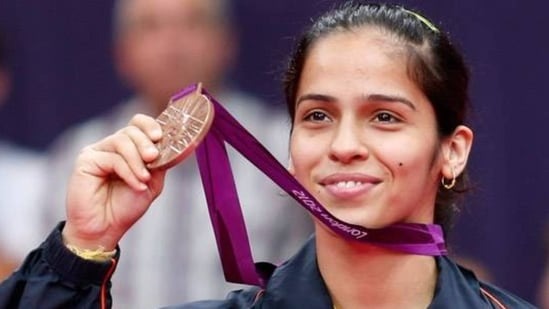
Her defining moment arrived at the London Olympics in 2012, where she became the first Indian badminton player to win an Olympic medal. She secured bronze after her opponent retired injured during the third-place playoff, a landmark achievement that eclipsed her quarterfinal finish at the Beijing Games four years earlier.
Saina regained the world No. 2 ranking in 2013, but her most significant breakthrough came in 2015. After reaching the All England final and lifting her maiden India Open title, she became the first Indian woman to attain the world No. 1 ranking—an ambition she had long cherished. Later that year, she added another historic first by winning silver at the World Championships, becoming India’s first medallist at the event.
Her career suffered a major setback at the Rio 2016 Olympics, where a serious knee injury threatened to derail her journey. Staying true to her reputation for resilience, Saina staged a strong comeback, winning bronze at the 2017 World Championships and reclaiming Commonwealth Games gold in 2018. Persistent knee problems, however, continued to affect her consistency in the years that followed.
In all, Saina Nehwal finished her career with 24 international titles, including 10 Super Series victories. Her impact on Indian sport was recognised with the Padma Bhushan in 2016, in addition to the Major Dhyan Chand Khel Ratna and the Arjuna Award—honours befitting a trailblazer who transformed the landscape of Indian badminton.