


Indian and American officials have postponed a three-day meeting scheduled this week to advance talks on an interim trade agreement, according to people familiar with the matter. The delay is likely to disrupt the March deadline that New Delhi and Washington had earlier set for finalising the pact.
The development follows a major ruling by the Supreme Court of the United States on Friday, which struck down President Donald Trump’s use of emergency powers to impose tariffs. The decision has forced the US administration to explore alternative legal routes to maintain its tariff regime.
For now, Washington has invoked Section 122 of the Trade Act of 1974, which allows temporary tariffs but limits them to 15% and a 150-day duration. Officials are also examining Section 338 of the Tariff Act of 1930, a provision that could permit tariffs of up to 50%, potentially bypassing existing caps.
People aware of the discussions said the rapid legal shifts have created uncertainty, complicating negotiations. “The US initially cited Sections 232, 301 and 122 after the court verdict. Now Section 338 is under consideration. In such a fluid situation, it is difficult to conclude any durable agreement between two sovereign nations,” one person said, requesting anonymity.
Another official confirmed that the visit of India’s chief negotiator, Darpan Jain, scheduled for Sunday, has been postponed. Both sides agreed to reschedule after assessing the implications of the latest developments. “The meeting will take place at a mutually convenient date once there is greater clarity,” the person said.
The postponement casts a shadow over the broader negotiating calendar. This week’s engagement was intended to finalise the legal text of the interim bilateral trade deal ahead of an expected March visit by US Trade Representative Jamieson Greer to sign the agreement. Officials indicated that related meetings on both sides are now on hold.
India’s commerce ministry said it was closely examining the US court ruling and subsequent announcements. “We have noted the US Supreme Court judgment on tariffs. Some steps have been announced by the US administration. We are studying these developments for their implications,” the ministry said in a statement.
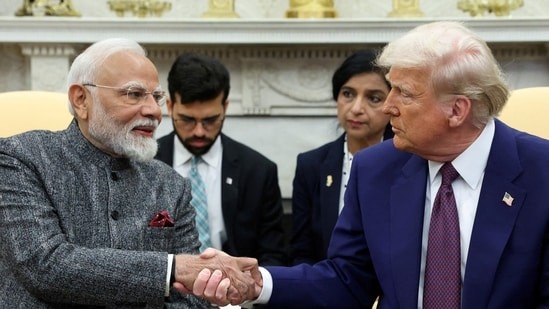
The interim deal framework had been agreed upon in a joint statement issued on February 6, when both countries committed to concluding a limited agreement in March, ahead of negotiations for a broader bilateral trade pact envisioned by Trump and Prime Minister Narendra Modi.
Officials noted that the evolving tariff mechanisms represent changes in key components of the framework, potentially requiring recalibration on both sides. The February 6 statement allows for such adjustments, stating that either country may modify its commitments if agreed tariff levels change.
US Treasury Secretary Scott Bessent signalled on Sunday that Washington would continue pursuing alternative legal avenues. In a post on X, he said the court ruling only barred the use of emergency powers under IEEPA to raise revenue and that the administration would shift to “proven authorities” such as Sections 232, 301 and 122 to sustain its tariff strategy.
Subsequent reports indicated that Section 338 could also be deployed, potentially allowing tariffs of up to 50%.
The rapid shifts in tariff policy since Friday have unsettled exporters. Tariffs on Indian goods had previously climbed to 50%, before falling to 25% in early February and later easing to 18% under the bilateral framework. Following Friday’s ruling, they briefly dropped to 10%, only to rise to 15% on Saturday — the maximum allowed under Section 122.
For India, the current 15% rate remains lower than the 18% level outlined in the recent framework and significantly below the earlier 26% “Liberation Day” rate.
Analysts at Emkay Global Financial Services described the Supreme Court ruling as a positive development for India, arguing that the US had lost immediate tariff leverage in global trade negotiations. In a subsequent note, analysts suggested India may reassess the terms of its proposed deal with the US amid the softer tariff environment.
However, uncertainty persists. Section 122’s 150-day limit continues to run, and the administration has yet to clarify its long-term legal strategy. Neal Katyal, the lawyer who challenged the tariffs in court, argued that sweeping tariff policies require congressional approval. “If the tariffs are such a good idea, the President should persuade Congress. That is what the Constitution requires,” he said.
The Supreme Court’s ruling underscored this principle, stating that broad tariff authority rests with lawmakers in the US Congress and cannot be unilaterally exercised by the President.