


NEW DELHI: Respondents will be able to answer caste-related questions in Census 2027 using state- and Union Territory-specific lists of Scheduled Castes (SCs) and Scheduled Tribes (STs) provided with self-enumeration forms, according to an official FAQ.
“The Census of India has compiled and shared caste lists for all states and UTs. If a respondent’s caste or tribe is not listed, they can select the ‘Other’ option,” the FAQ states.
It also clarifies that each state and UT has its own notified lists of SCs and STs, without referring to a central list. The FAQ section has been included on the self-enumeration portal to help citizens respond accurately to census questions.
The fully digital Census 2027 will be conducted in two phases starting next month. Enumerators will use a dedicated mobile application to collect data. The government has notified 33 questions for the first phase—Housing Listing and Housing Census—which begins on April 1, 2026. The second phase will focus on population enumeration.
The FAQ addresses several nuanced queries, including those related to live-in relationships. It states that couples in such relationships should be considered married if they regard their union as stable.
Other questions covered include details about housing materials, drinking water sources, number of married couples in a household, gender of the head of the household, and types of food consumed. It also clarifies that a mobile phone with FM functionality can be counted as a ‘radio’, recorded as “On Mobile/Smartphone”.
On Monday, the Ministry of Home Affairs announced the schedule for housing listing and self-enumeration across states and UTs via a PIB release. The self-enumeration phase, lasting 15 days, will begin on April 1 in states such as Odisha, Karnataka, Goa, and Lakshadweep, followed by the 30-day houselisting exercise starting April 16.
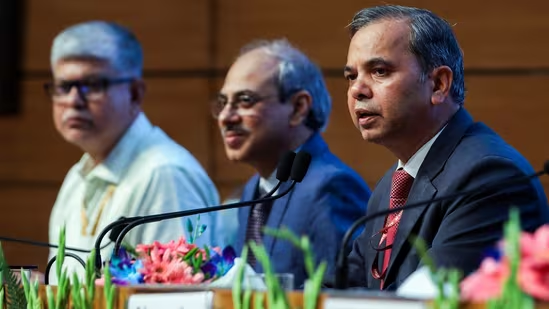
Registrar General and Census Commissioner of India, Mritunjay Kumar Narayan, said the first set of census data is likely to be released next year—much earlier than in previous cycles—thanks to digital tools enabling real-time monitoring and automated validation.
He urged citizens to provide accurate information, assuring that all individual data will remain strictly confidential. “The data cannot be shared with any organisation, public or private, nor can it be used as evidence in court or for availing benefits under any scheme,” he said, citing Section 15 of the Census Act.
Narayan also noted that West Bengal has yet to issue a notification for conducting the Census. The matter has been raised with the state government, which is heading into assembly elections next month. He expressed confidence that the notification will be issued soon, adding that the deadline for completing the first phase is September 30.