

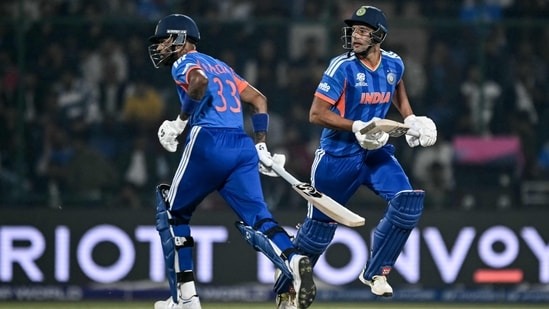

Despite registering two wins from two games, India’s T20 World Cup campaign has been anything but smooth with the bat. While half-centuries from Suryakumar Yadav, Ishan Kishan and Hardik Pandya have stood out, the team’s batting hasn’t quite mirrored the dominant form that saw them dismantle South Africa and New Zealand in the lead-up to their title defence.
India beat the United States by 28 runs in Mumbai and Namibia by 93 runs in Delhi, but both victories were accompanied by worrying collapses. The surfaces at the Wankhede and Arun Jaitley Stadium were far from batting paradises. Mumbai offered lateral movement and turn, while the Delhi pitch was initially tacky and two-paced before easing out.
Against the United States, India were in deep trouble at 77 for six before their captain rescued the innings. The collapse was triggered by medium-pacer Shadley van Schalkwyk, who produced a career-best spell. Though that wobble could be attributed to early-tournament nerves, further batting stutters against Namibia raised fresh concerns.
In Delhi, India suffered two mini-collapses — first losing three wickets for 20 runs, and later five wickets for four runs at the death. The initial slide was engineered by Namibia skipper Gerhard Erasmus and left-arm spinner Bernard Scholtz. Erasmus, primarily a batter, relied on clever variations including a slinging action and unusual release points to outfox India’s top order, while Scholtz combined flight and subtle turn to remove key batters, including Suryakumar Yadav.
The upcoming clash against Pakistan at the Premadasa Stadium in Colombo promises an even sterner examination. Pakistan fielded five spin options in their previous outing at the venue, with Shadab Khan, Abrar Ahmed, Saim Ayub, Mohammad Nawaz and Usman Tariq forming a varied and potent attack. Tariq, in particular, has impressed early in his international career with his deceptive action and impressive economy rate.
India’s recent vulnerability against spin will undoubtedly be a concern for the team management. While the late-order run-outs against Namibia may not warrant overreaction, the earlier collapses highlight technical and tactical issues that need urgent addressing.
Neither the United States nor Namibia were able to fully capitalise on India’s batting lapses. Pakistan, however, are unlikely to be as forgiving — especially on a Colombo surface expected to assist spin. As India head into the high-stakes encounter, tightening their approach against slow bowling will be paramount.