


India and the European Union (EU) are gearing up for a series of high-level engagements across key areas such as security, the Indo-Pacific, and technology, as both sides move closer to formally signing their long-awaited Free Trade Agreement (FTA) by the end of this year, officials familiar with the developments said.
The two partners are also closely coordinating on the evolving security situation in West Asia, particularly focusing on ensuring freedom of navigation and the uninterrupted flow of maritime trade. Discussions have included potential cooperation to safeguard shipping routes once hostilities involving Iran subside.
A packed schedule of engagements is being lined up, beginning with a visit later this month by an 11-member delegation from the European Parliament focused on India ties. This will be followed by Indo-Pacific consultations in May and a meeting of the Trade and Technology Council (TTC) in late June. Several EU commissioners overseeing key strategic areas are also expected to visit New Delhi in the coming months.
Established in 2022, the TTC serves as a platform for cooperation in trade, investment, resilient supply chains, and digital and green technologies. Notably, the EU has set up such a mechanism only with India and the United States.
In parallel, both sides are preparing to launch negotiations on a Security of Information Agreement (SoIA), which aims to enable the sharing of sensitive information and boost collaboration in critical sectors, including defence manufacturing. Talks on an investment protection agreement and geographical indications are also set to resume, with an aim to conclude the SoIA within the year.
Recently, India and the EU held the first edition of their enhanced security and defence dialogue on the sidelines of the Raisina Dialogue in New Delhi, focusing on maritime security, cybersecurity, and counter-terrorism cooperation.
Regarding the FTA, both sides are currently working through final technical steps, including legal reviews and resolution of outstanding issues, before submitting the agreement to the European Council for approval. The deal is expected to be formally signed by the final quarter of the year, possibly by November.
Following this, the agreement will require approval from the European Parliament before coming into force, which is anticipated by January 2027.
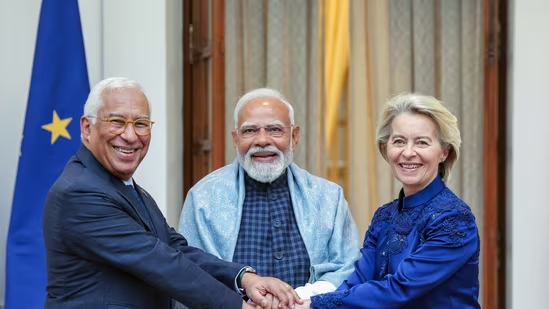
The FTA negotiations—often described as the “mother of all deals”—were concluded during the India-EU summit in New Delhi on January 27, attended by Prime Minister Narendra Modi, European Council President Antonio Costa, and European Commission President Ursula von der Leyen. The agreement reflects a shared vision to strengthen a rules-based global trade order amid rising geopolitical and economic uncertainties.
Recent high-level interactions, including External Affairs Minister S. Jaishankar’s participation in the EU Foreign Affairs Council in Brussels and his meetings with key EU leaders, underline the commitment on both sides to accelerate progress and deepen engagement.
Officials noted that the shifting global geopolitical landscape has further enhanced the importance of the India-EU partnership, particularly in ensuring stability and predictability in international relations.