

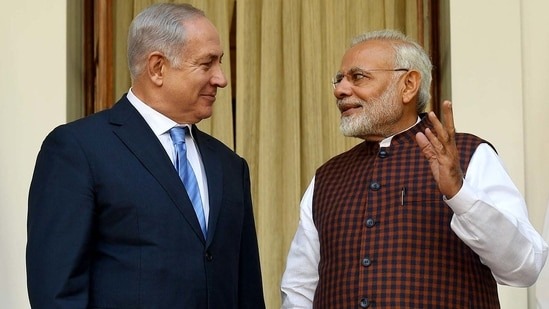

As Prime Minister Narendra Modi prepares for his second visit to Israel, speculation is mounting over whether New Delhi could be drawn into a new regional alignment. Israeli Prime Minister Benjamin Netanyahu has proposed what he calls a “hexagon” of alliances across and around the Middle East — and has named India as a key partner.
Modi’s two-day visit from February 25 to 26 will include an address to the Knesset and discussions focused on technology, trade and security cooperation.
What is the ‘hexagon’ plan?
At a recent cabinet meeting, Netanyahu described India as a “global power” and referred to Modi as a personal friend. He said Israel aims to create a “hexagon” framework bringing together India, Arab nations, African nations, Mediterranean partners such as Greece and Cyprus, along with other Asian countries he did not name.
According to Netanyahu, the grouping would serve as an “axis of nations” aligned against what he described as radical forces in the region — both a “radical Shia axis” and an “emerging radical Sunni axis.” He argued that countries sharing similar assessments of regional challenges could enhance their collective resilience and long-term stability through closer coordination.
While the concept overlaps in part with the connectivity ambitions of the India-Middle East-Europe Economic Corridor, Netanyahu framed it as a broader strategic and diplomatic alignment rather than purely an economic initiative.
Limited endorsement so far
None of the countries mentioned by Netanyahu has formally endorsed the proposal or its framing.
Notably, Greece and Cyprus are members of the International Criminal Court, which has issued an arrest warrant against Netanyahu over alleged war crimes in Gaza. As ICC signatories, they would be legally obliged to act on such a warrant if he were to enter their territory.
Netanyahu’s remarks have also drawn criticism elsewhere. Pakistan’s Senate passed a resolution condemning what it described as attempts to forge alliances targeting certain states. The resolution, moved by Senator Palwasha Khan of the Pakistan Peoples Party, criticised what it called provocative steps by the Israeli leadership and reaffirmed Pakistan’s support for the Palestinian cause.
Will India join?
India’s response remains unclear. Historically, New Delhi has avoided rigid geopolitical blocs, instead pursuing a strategy of multi-alignment — maintaining ties with the United States, Russia and China while also strengthening partnerships across West Asia.
India’s longstanding relationship with Iran adds further complexity. The Gulf region is also economically vital for India, hosting millions of Indian workers whose remittances are significant to the domestic economy.
Andreas Krieg, associate professor of security studies at King’s College London, told Al Jazeera that the proposed alignment risks deepening regional polarisation and could provide rivals such as Iran and Turkey with a narrative of encirclement. He suggested that some prospective partners may hesitate to appear too closely aligned with Israel.
Krieg argued that India’s primary interests lie in defence, technology and trade rather than advancing Israel’s regional strategic blueprint. He described the “hexagon” less as a formal alliance and more as a branding exercise built around existing bilateral relationships, rather than a NATO-style pact.
What’s on Modi’s agenda?
During the visit, the two leaders are expected to expand cooperation in high-technology sectors, including artificial intelligence and quantum computing. Modi will also attend an innovation event in Jerusalem, visit Yad Vashem alongside Netanyahu, and meet Israeli President Isaac Herzog.
Netanyahu noted that ties have strengthened steadily since Modi’s landmark 2017 trip — the first by an Indian prime minister to Israel — followed by his own visit to India in 2018. He emphasised that the upcoming meetings aim to further deepen economic, diplomatic and security cooperation between the two countries.