

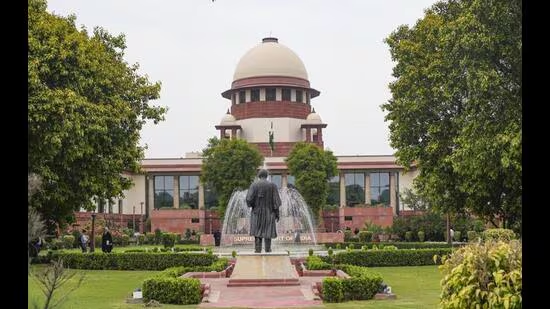

The Supreme Court on Tuesday ruled that individuals who convert to Christianity or any religion other than Hinduism, Sikhism, or Buddhism lose their Scheduled Caste (SC) status and the constitutional protections associated with it.
A bench comprising Justices Prashant Kumar Mishra and Manmohan upheld a judgment of the Andhra Pradesh High Court, stating that once a person voluntarily converts and practices another religion, they are no longer entitled to benefits linked to SC identity. This includes protection under the SC/ST (Prevention of Atrocities) Act.
The court affirmed that the Constitution (Scheduled Castes) Order, 1950, limits SC status to specific religions. It emphasized that the key factor is the religion a person professes at the time of the incident, not merely the possession of a caste certificate.
The case involved a pastor from Andhra Pradesh, Chinthada Anand, who had filed a complaint alleging assault and caste-based abuse. The accused challenged the case, arguing that Anand had converted to Christianity and was therefore not eligible to invoke the SC/ST Act.
The Supreme Court noted that Anand had been practicing Christianity for over a decade and actively working as a pastor. It also observed that there was no claim of reconversion or re-entry into his original caste. Based on these facts, the court concluded that he was not entitled to SC status or related legal protections.
The ruling supports the Andhra Pradesh High Court’s April 30, 2025 decision, which had quashed the criminal proceedings. The High Court had stated that the caste system does not apply to Christianity and that individuals who convert cannot claim benefits meant to address caste-based discrimination within Hindu society and its legally recognized extensions.
The High Court also clarified that holding a caste certificate does not guarantee eligibility under the SC/ST Act after conversion. It noted that the validity of such certificates is a separate administrative matter governed by state law and does not override the legal consequences of conversion.
The case originated from a 2021 complaint in Guntur district, where Anand alleged that villagers opposed his religious activities, assaulted him, and used caste-based slurs. Police had registered a case under the SC/ST Act and the Indian Penal Code.
One of the accused later approached the High Court, arguing that the SC/ST Act was wrongly applied. Agreeing with this, the court held that the law is meant only for members of Scheduled Castes and Scheduled Tribes and cannot be used by those who have left that category through religious conversion. Extending such protections, it said, would amount to misuse of the law.